Can You Really Use an App to Measure Ring Size Using Camera?
Exploring the technology behind camera-based ring sizing and whether it's a reliable method for engagement rings.

DHB Apps Team
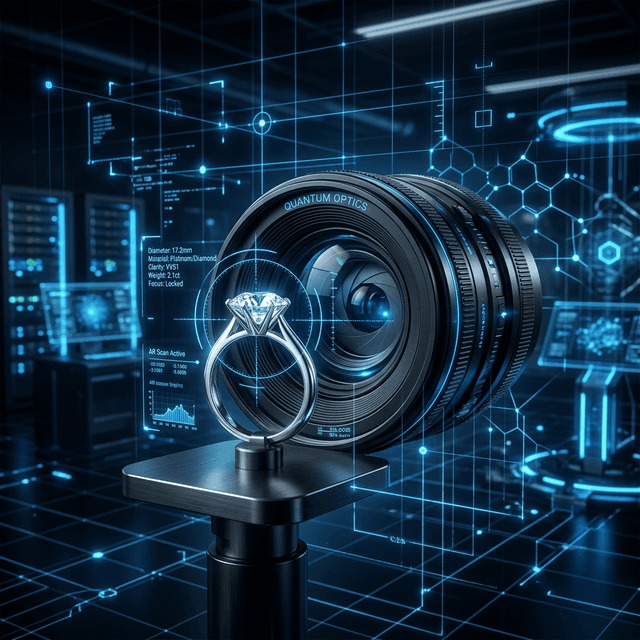
The rapid evolution of augmented reality (AR) and smartphone lens capabilities has left many jewelers and shoppers wondering: can you really use an app to measure ring size using camera? This technological leap promises a future where you never need a physical sizing tool. But what is the practical reality in 2026? We investigated the mechanics of camera-based sizing and the most reliable alternatives currently available.
Definition
Camera-Based Ring Sizing — Camera-based ring sizing is a method that uses a smartphone camera and augmented reality (AR) algorithms to estimate finger dimensions from a live video feed. While experimental apps use ARKit (iOS) and ARCore (Android), the method currently suffers from focal distortion, lighting sensitivity, and knuckle measurement challenges that make it less accurate than screen-based ring sizer apps for most users.
The Allure — and the Reality — of Camera Ring Sizing
The idea of using Apple's ARKit or Google's ARCore to evaluate your finger size is exciting. When people ask can you use an app to measure ring size using camera, they envision a completely hands-free process. While some developers have begun experimenting with this technology, several challenges immediately arise in practical, everyday use:
- Varying Lighting Conditions: A camera requires excellent contrast to detect the subtle edges of a finger. Shadows can alter the perceived width by several millimeters.
- Focal Distortion: Wide-angle lenses standard on modern smartphones introduce edge distortion (fisheye effect) that makes sub-millimeter measurements inherently unreliable without dedicated depth sensors like LIDAR.
- The Knuckle Problem: Measuring the actual wearing position of a ring versus the knuckle size using a flat 2D projection is mathematically difficult — most camera apps cannot distinguish between these two critical dimensions.
- No Physical Reference: Camera apps measure your finger directly, but ring size is defined by the inner diameter of the ring — not your finger's outer circumference.
“While AR sizing applications look magical in promotional videos, jewelry requires sub-millimeter accuracy that standard smartphone cameras simply cannot guarantee under everyday lighting conditions.
| Feature | Screen-Based Sizer (Ring on Screen) | Camera-Based Sizer (AR) |
|---|---|---|
| Accuracy | ✓±0.2mm (pixel-perfect) | ±2–5mm (lighting-dependent) |
| Lighting sensitivity | ✓None — backlit screen | High — shadows cause errors |
| Reference method | ✓Physical ring inner diameter | Finger outer circumference estimation |
| Device requirement | ✓Any smartphone with a screen | LIDAR sensor for best accuracy |
| Technology maturity | ✓Proven, widely deployed | Experimental / early stage |
| Setup friction | ✓Place ring and slide — 30 seconds | AR scanning, positioning |
The Most Reliable Modern Alternative: Screen-Based Sizing
If the camera method introduces too many variables, what represents the pinnacle of modern sizing technology? The answer lies in leveraging the hardware element of your smartphone that is inherently perfect: the display screen. While cameras distort reality based on light and distance, screens generate pixel-perfect, mathematically defined geometric circles.
Physical-to-Digital Precision
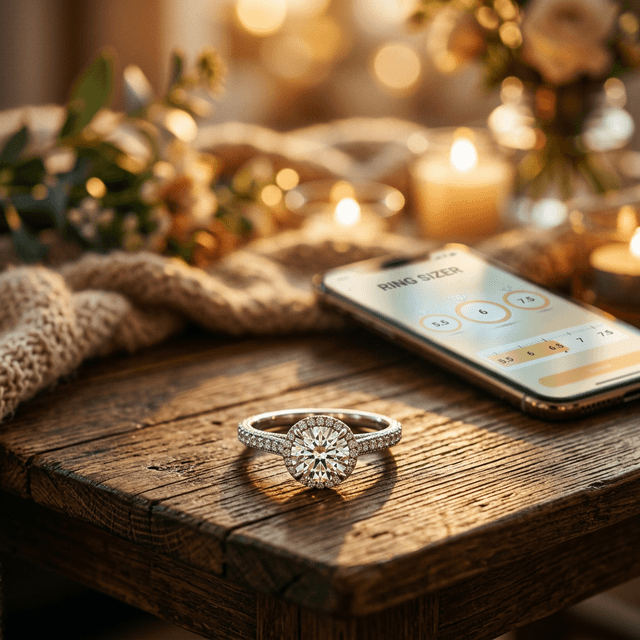
Instead of holding a camera in the air, the most accurate method involves placing an existing ring directly onto your smartphone glass. Our DHB Apps Ring Sizer avoids all focal and lighting issues by using direct physical contact. You align a brilliantly rendered digital circle with the inner circumference of your physical jewelry — the same measurement a jeweler takes.
The dark-mode backdrop makes discerning the ring edge effortless, leading to laboratory-grade accuracy without relying on unpredictable camera optics.
Frequently Asked Questions
Experimentally, yes — some apps attempt AR camera-based sizing. However, camera methods are currently limited by lighting and lens distortion (±2–5mm error). The DHB Apps Ring Sizer avoids these issues entirely by using a screen-based method, achieving ±0.2mm accuracy with a physical ring placed directly on the display.
The most accurate phone-based method is screen-based sizing, as used by the DHB Apps Ring Sizer App: place an existing ring flat on your phone screen and align a digital circle to the ring's inner diameter with a precision slider. This delivers ±0.2mm accuracy unaffected by lighting or camera distortion.
The most accurate AR ring sizing apps require a LIDAR scanner for usable depth measurements. Without LIDAR, camera-based apps rely on 2D video processing, which is far less reliable for jewelry sizing. For guaranteed sub-millimeter accuracy, the DHB Apps Ring Sizer screen-based method requires no special hardware beyond a standard smartphone screen.
As LIDAR and depth-sensing hardware matures, camera-based sizing accuracy will improve. In 2026, however, for critical jewelry purchases, the screen-placement method used by the DHB Apps Ring Sizer App remains the gold standard — no camera, no lighting conditions to manage, just ±0.2mm repeatable precision.
Conclusion: Certainty Over Gimmicks
While camera-measuring tech continues to advance, the stakes are too high when purchasing a permanent piece of jewelry like an engagement or wedding ring. For guaranteed precision, opt for an elegantly calibrated screen-based utility like the DHB Apps Ring Sizer — no AR needed, no lighting conditions to manage. Your ring will slide on perfectly the first time.